What is a GEO audit? AI-search readiness, explained
What a GEO (generative engine optimisation) audit can and cannot check: AI crawler access, content structure, entity consistency, sources and snippet controls.
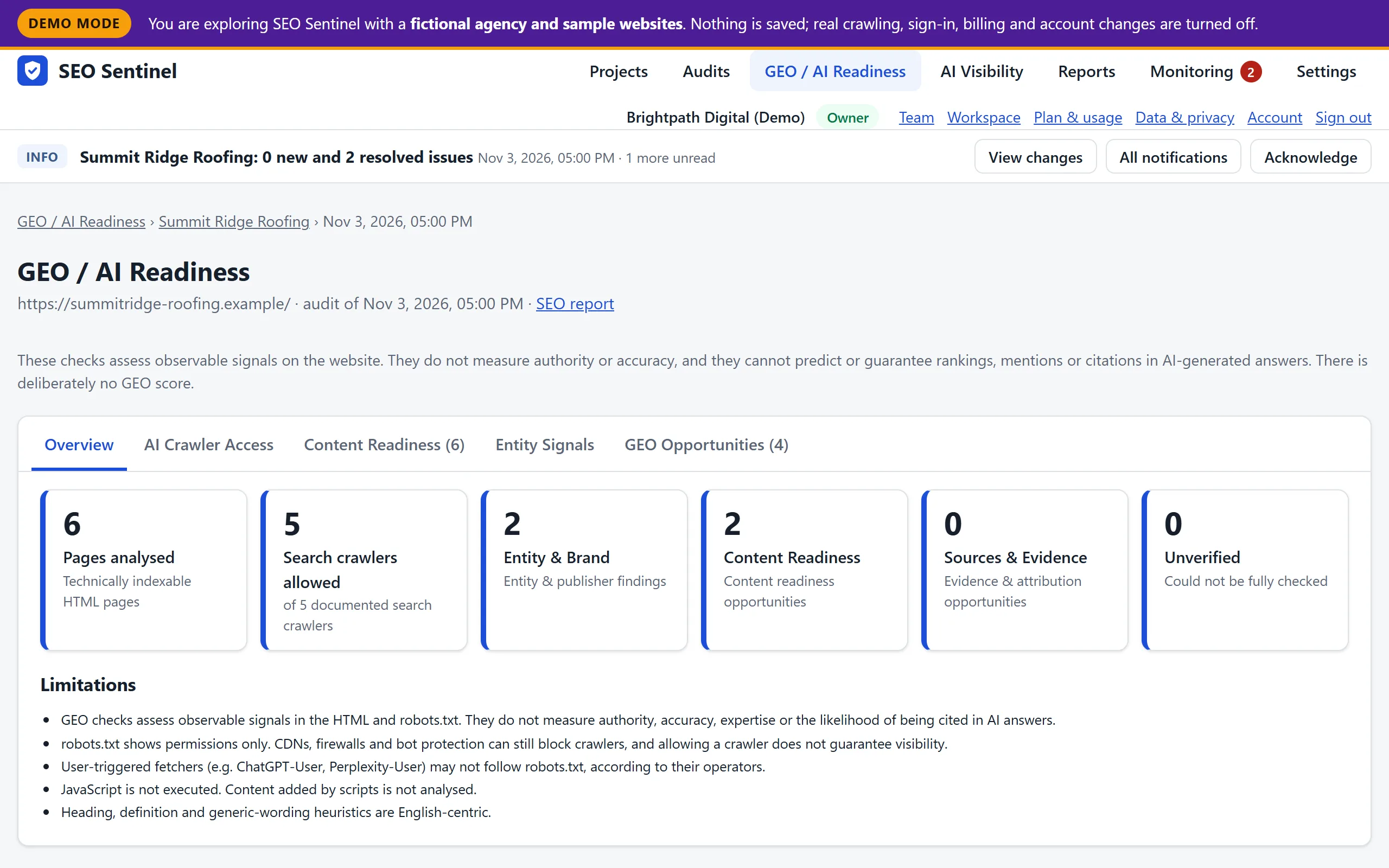
Draft · under reviewGenerative engine optimisation (GEO) readiness checks run with every SEO Sentinel audit. They look at what you can observe on the site itself: which AI crawlers robots.txt allows, how content is structured, whether the brand is described consistently, and whether articles show authors, dates and sources.
A GEO audit can tell you whether AI search crawlers are allowed in and whether pages are easy to parse and attribute. It cannot tell you whether ChatGPT, Gemini or Perplexity will mention or cite the site. SEO Sentinel says so on every GEO report, and there is no GEO score.
Google states that its AI features in Search have no additional requirements beyond normal Search eligibility, so most suggestions here are simply good practice for readers and search in general. That is how we present them.
The checks reuse the same crawl as the technical audit: no extra page requests, no AI API calls and nothing sent to any AI service.
robots.txt rules are tested for 13 documented crawlers and tokens on up to 20 important URLs, using standard RFC 9309 precedence: a crawler’s own group replaces *, the longest matching rule wins, and the rule’s line number is shown as evidence.
| Purpose | Examples | How SEO Sentinel treats it |
|---|---|---|
| AI search | OAI-SearchBot, Claude-SearchBot, PerplexityBot | Blocking these is reported, because it can keep a site out of those AI search features. |
| Search engine | Googlebot, Applebot | Googlebot also crawls for Google’s AI features in Search. |
| AI training | GPTBot, ClaudeBot | Blocking training is a business decision, not an error. |
| Training opt-out token | Google-Extended, Applebot-Extended | robots.txt tokens only; no separate crawler visits. |
| Dataset | CCBot (Common Crawl) | Builds an openly available web dataset. |
| User-triggered fetcher | ChatGPT-User, Claude-User, Perplexity-User | Their operators say robots.txt may not apply to user-initiated fetches. |
The crawler registry is checked against each operator’s own documentation. Vendors add and rename crawlers, so it is maintained over time. Read the AI crawler robots.txt guide.
nosnippet, max-snippet:0, data-nosnippet), which also limit Google’s AI featuresPages are never flagged just for having no FAQ or question headings.
og:site_name, titles and the copyright linetel: linkEvery GEO finding has a severity (never a “confirmed error”), a verification level (confirmed, likely or unverified) and a scope: sitewide/template when it repeats on at least 5 pages and 60% of comparable pages, otherwise page-specific.
What a GEO (generative engine optimisation) audit can and cannot check: AI crawler access, content structure, entity consistency, sources and snippet controls.
Draft · under reviewWhich robots.txt tokens control AI search, AI training and user-triggered fetchers (GPTBot, OAI-SearchBot, ClaudeBot, Google-Extended) and how to test them.
Draft · under reviewSee AI crawler access, content readiness, entity signals and GEO opportunities for fictional client websites.
SEO Sentinel is in private beta. Nothing is for sale yet and no card is ever requested.